A short in-office treatment that uses injectable collagen biostimulators to thicken thin, receding gum tissue — no cutting, no tissue taken from the roof of your mouth, no stitches, and no weeks of recovery.
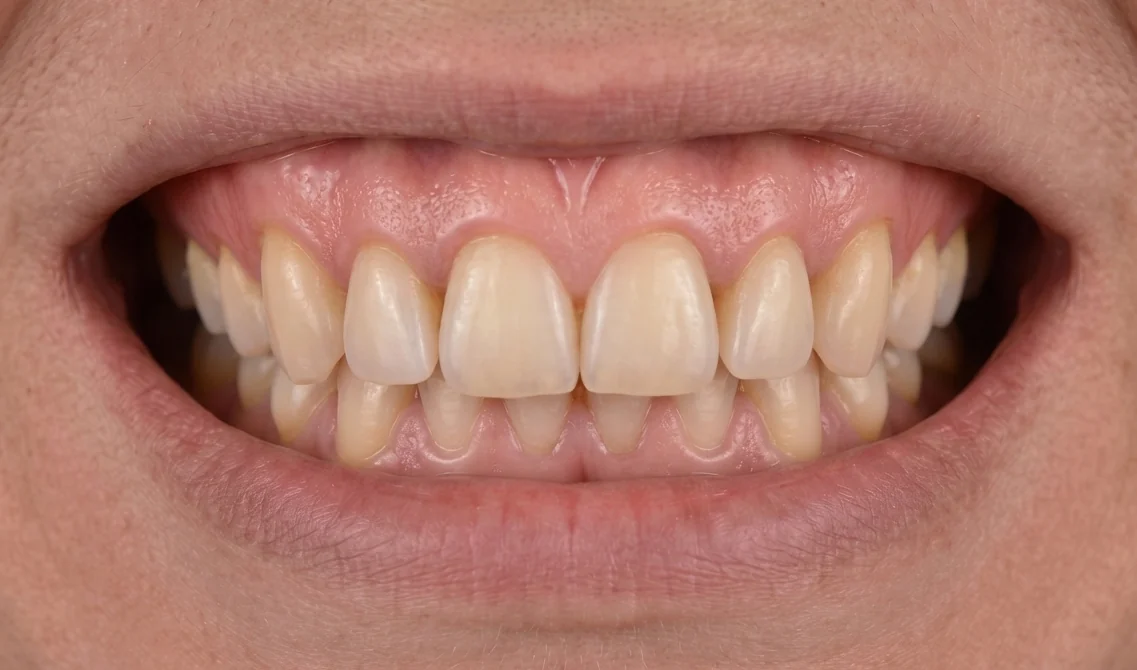
Two things change when receding gums are restored: the darker root surface at the neck of each tooth is covered again, and the dark triangular gaps between the teeth close up.
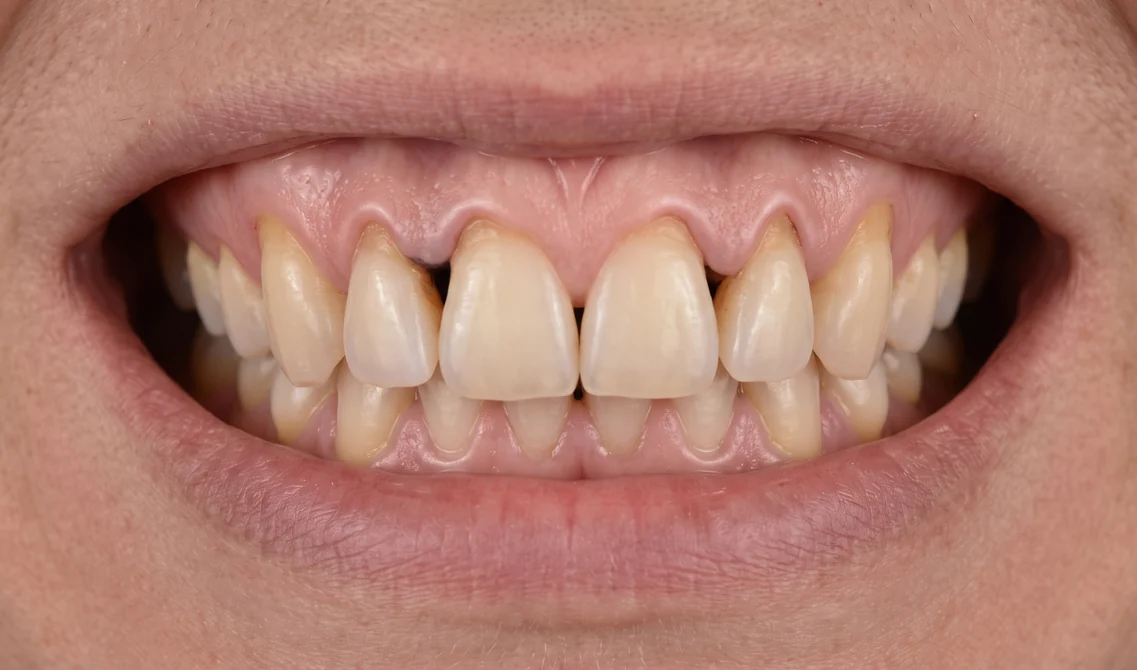
Illustration — digital simulation, not an actual patient. This image was generated to explain what gum recession looks like and what a restored gum line looks like. It is not a photograph of a Rozenberg Dental patient and it is not a promise of any particular result. Individual outcomes depend on the amount of recession, the bone underneath, and how your tissue responds.
Gum recession happens when the gum margin creeps away from the tooth and exposes the root underneath. Root surface is softer and darker than enamel, so a receding gum line reads as longer, more yellow teeth — and it often comes with cold sensitivity and food catching at the gumline.
The established fix is a gum graft: a periodontist harvests tissue from the roof of your mouth and sutures it over the exposed root. It works well, but it is surgery, and the donor site is the part most patients dread.
Injectable gum regeneration takes a different route. A collagen biostimulator is placed into the gum tissue around the recession with a very fine needle. It is not a cosmetic filler doing the work — the material acts as a scaffold that signals your own fibroblasts to lay down fresh collagen. Over the following weeks the tissue thickens from the inside out, using your own biology rather than a donor graft.
Dr. Rozenberg works with two biostimulators and selects between them case by case, based on how much volume is missing and how thin the surrounding tissue is.
The visible part takes minutes. The part that matters happens quietly over the following weeks, as your own tissue responds to the scaffold that was placed.
The gel carrier the material is suspended in lifts and supports the gum tissue the moment it is placed. This is the change you can see on the day — and it is the smallest part of the story.
Same visitThe material stays behind as a scaffold. Fibroblasts in the gum migrate along it and begin producing new Type I and Type III collagen. The tissue gradually becomes thicker and more resilient than it was — built by you, not implanted.
Weeks to monthsThe carrier and the particles are gradually absorbed and cleared by the body. What remains is the collagen network your own cells laid down along the way.
GradualTick anything that sounds like your mouth. Nothing is stored or sent — this runs entirely in your browser and is only meant to help you decide whether a consultation is worth your time.
This self-check is an educational tool, not a diagnosis. Only a clinical exam — including measuring the recession and checking the bone level underneath — can determine whether you are a candidate.
These are not competing brands of the same thing. They work differently, and the right one depends on whether your tissue needs volume, structure, or both.
Grafting is a proven, excellent procedure. This is not a replacement for it — it is a different option for a different stage of the problem.
Dr. Rozenberg measures the recession at each affected tooth, checks the health of the gum and the bone level beneath it, and rules out active gum disease. If something else is driving the recession — a heavy bite, aggressive brushing, grinding — that gets addressed first.
Photographs and measurements are taken so there is an objective baseline to compare against later. This is also where the choice between materials is made and explained, including any off-label use.
The area is numbed with local anesthesia before anything is placed. Patients generally describe the treatment itself as easier than a routine filling.
The biostimulator is placed into the gum tissue around the recession through a very fine needle, in small precise amounts. Ten to fifteen minutes for the treatment itself. No incisions, no stitches.
There is no surgical site to protect and no donor wound on your palate. You will be given aftercare guidance, and some tenderness or minor swelling for a few days is normal.
You are seen again so the tissue response can be measured against the baseline records. Depending on the material used and what is found, a further session or a maintenance interval is planned from there.
A treatment is only worth having if you know what it does not do.
Rozenberg Dental sits at 45 West 54th Street, between Fifth and Sixth Avenues — a short walk from Rockefeller Center, MoMA, and the Plaza District. For an appointment that takes about fifteen minutes in the chair and needs no recovery time, that location matters: patients routinely come in around a working day rather than planning around it.
The nearest subway stops are 5 Av/53 St on the E and M, and 57 St on the F. Penn Station and Grand Central are both a short ride away, which is why a good share of the practice’s patients commute in from Westchester, Long Island and New Jersey.
Because this treatment involves no scalpel, no palatal donor site and no sutures, there is nothing to protect afterwards and no follow-up surgery to schedule — you leave the office and get on with your day in Midtown.
Real Google reviews from Rozenberg Dental patients. These describe the practice’s wider gum and hygiene care rather than this specific treatment, which is newly offered. Read all 264 reviews
Rachel is by far the best dental hygienist I’ve ever gone to in my life! She recommended a full scaling and my gums have never been better. I haven’t had an issue in almost a year thanks to this procedure. She’s a pro, extremely thorough. Would HIGHLY recommend.
Dr. Rozenberg and her team are truly exceptional. Tanya, my hygienist, is incredibly thorough and has made a real difference in my dental health — and honestly, my life.
They are fantastic. I was having some difficulties with insurance and despite this they gave me honest and genuine advice based on the limited information they could see. I’m very grateful for their kindness, this may have saved me a lot of pain in the future.
A consultation gives you a measured answer: how much recession there is, what is underneath it, and whether injectable regeneration, gum grafting, or simply better maintenance is the honest recommendation for you.